


ODE TO CARNIVORISM
- Kasya Das

- 4 days ago
- 4 min read

Human beings possess a peculiar gift: we can feel pity, empathy, fear, and compassion — and yet we kill billions of creatures every day because… well, because it tastes good. That is the dark beauty of human nature — we can live with a moral contradiction larger than any planet in our universe.
They say man is the lord of creation. A charming fairy tale — especially when you realize that his greatest “dominion” consists of turning every creature into a schnitzel. From chicken to cow, everything can be breaded and fried.
Why do we eat meat? The answer falls into two categories: honest and civilized.
Honest: Because it tastes good. Because grilled ribs smell better to me than raw carrots. Because a steak makes you feel like a hunter — even if you brought it home from the supermarket freezer.
Overcivilized: Because of protein, nutrition, evolution, culture, and tradition. In short, scientific excuses for the fact that we enjoy killing, but prefer to look dignified while doing it.
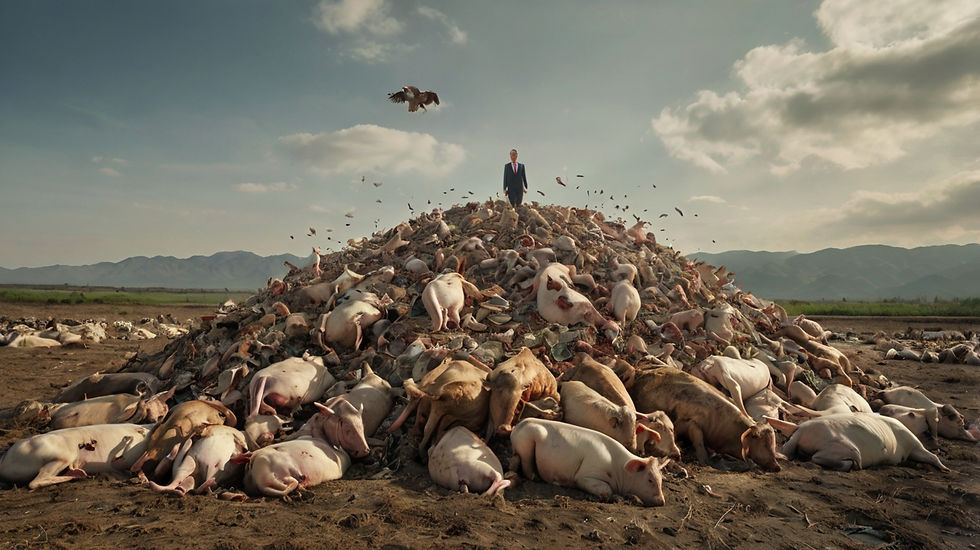
The mass killing of animals is not merely the result of hunger or survival. It is a psychological calculation people perform every day, often unconsciously: “I can feel compassion, but I also have cravings. I’ll let compassion sleep for a while. Craving wins.” Thus the victim becomes a product, individuality becomes a number, and life becomes a caloric unit.
Why mass killing? Because humans are social creatures — and collective behavior strengthens moral disconnection. If everyone around you eats meat, it seems normal. And normal is comfortable. Comfort is stronger than ethics because comfort is tangible — a steak on a plate, a hamburger in your hand — whereas ethics is abstract, distant, and usually squeezes the conscience only briefly before we turn away.

Mass killing is also a game of power. Man holds power over the lives of other creatures, and that power is sweet. In every butcher shop, every meat factory, every farm, there is a quiet demonstration of dominance: “I decide when your life ends.” We justify it with biology, tradition, taste — but beneath it lies an archaic sense of dominance and hostility, transferred from primitive ego to supermarket consumers. The primitive hunter at least has the pride to look into the eyes of the unfortunate creature he kills and see the blood flow. The “civilized” human rarely does.
Then comes dehumanization — or rather, de-animalization. Numbers and statistics replace individual life. We don’t see a cow; we hear “feeding a hungry population.” We don’t see a chicken; we see “hundreds of tons of meat.” We lose contact with reality, and our inner compass shifts from empathy to abstraction.
The dark humor lies in this: we can cry over a film about dying love, yet at the thought of a slaughter line we switch off the fuse of basic compassion. That is our mass blindness — the ability to feel deeply for distant suffering while ignoring the pain that exists immediately for our own comfort.

And yet, if we look deeper, meat is not just food. It is a mirror of our nature — our capacity to love and to ignore, our fear and greed, our survival instinct and the laziness of conscience. Mass animal killing is how humanity says to the world: “I am at the top of the chain — whether my heart likes it or not.”
So we kill and eat en masse. Not because we must. Not because we have no alternatives. But because habit, comfort, and the desire for dominance merge with our dark ability to silence empathy when it benefits us.
When you think about it, carnivorism is a genius system. The animal is born, perhaps given a name (if lucky), then a number (if not), and finally ends up in a hamburger. We call it “the cycle of life.” From the cow’s perspective, it is more like “the cycle of hell.”
Vegans ask: “Why do you do it when plants exist?”The meat-eater replies: “Because tofu has never made that beautiful sizzling sound of fat on a pan.” That is the entire philosophy summed up in one sentence.
Now imagine animals had ID cards and passports. A cow at customs presenting her passport: “Destination: Italy. Specialty: carpaccio.” A chicken receiving a biometric ID with a claw print and the note: “Lays daily.” Perhaps then we would realize we are killing neighbors — but we prefer to close our eyes as long as the meat is neatly wrapped in plastic.
So why eat meat? Because we like the taste, because we are too lazy to seek alternatives, and because herds do not defend themselves in court. And why kill animals? Because it is the simplest way for humans to prove they are at the top of the food chain.
Until the day cows learn to write satirical essays about us, we will keep killing them and eating them.
And if this offended you — that was the point.


Comments